
Home Remodel Finance Guide
How to Finance a $200,000+ Home Remodel in New Hampshire Without Budget Surprises

A $200,000+ home remodel usually does not go sideways because the homeowner picked the wrong backsplash, faucet, flooring, or cabinet pull.
It goes sideways because the budget was built on a guess.
A rough estimate.
A vague scope.
A “we’ll figure it out as we go” construction process.
And when financing is involved, that guess can quickly turn into a very expensive problem.
If you are planning a major home remodel in New Hampshire — whether it is a luxury kitchen remodel, a large home addition, a whole home renovation, a basement transformation, or a major primary suite upgrade — one of the biggest questions is:
How do we pay for this without creating a financial nightmare?
For many homeowners in Southern NH, Merrimack, Bedford, Windham, Amherst, Hollis, Nashua, the Seacoast, and the Lakes Region, the concern is not just whether they can afford the remodel.
The deeper concern is whether they can trust the number they are being asked to finance.
Because if the budget is wrong at the beginning, the financing strategy may be wrong too.
This guide will walk you through the most common ways to finance a $200,000+ home remodel in New Hampshire, including HELOCs, home equity loans, cash-out refinancing, renovation loans, and cash reserves.
More importantly, we will explain why your financing conversation should start with one thing:
A clear remodel plan before you borrow money, sign a contract, or commit to construction.
Before You Choose a Loan, Know What You Are Actually Financing
Most homeowners start the financing conversation too early.
They talk to the bank before the scope is defined.
They ask, “How much can we borrow?” before they know what the project should actually cost.
They compare loan options while still working from a contractor’s rough verbal estimate.
That is backwards.
Before you decide how to finance your remodel, you need to know what you are actually financing.
Are you remodeling the kitchen only?
Are you removing walls?
Are you relocating plumbing?
Are you upgrading electrical?
Are you adding square footage?
Are you finishing a basement?
Are you renovating the whole first floor?
Are you creating a luxury primary suite?
Are you trying to stay within a certain investment range, or are you trying to maximize the long-term value and enjoyment of the home?
Those details matter.
A $200,000 project can quickly become a $275,000 project if the scope, selections, design, and construction details are not clearly defined upfront.
That is why On The Mend Home Renovations uses a design-first planning process through our Renovation Roadmap Design Consult.
The purpose is simple:
Do not finance a guess. Finance a plan.
Option 1: HELOC for a Major NH Home Remodel
A Home Equity Line of Credit, commonly called a HELOC, is one of the most popular ways homeowners finance large remodeling projects.
A HELOC works like a credit line secured by your home’s equity. You are approved for a maximum borrowing amount, but you only draw what you need, when you need it.
For a major home remodel in New Hampshire, this can be attractive because construction payments are often made in stages.
Why Homeowners Like HELOCs
A HELOC gives you flexibility.
If your project is phased, you may not need to draw the full amount immediately. This can help you avoid paying interest on money you are not yet using.
A HELOC may also allow you to keep access to extra funds in case you choose to upgrade certain selections, expand the scope, or handle unexpected conditions.
For homeowners with strong equity in towns like Bedford, Windham, Hollis, Amherst, Merrimack, or around the Lakes Region, a HELOC may provide meaningful access to capital without restructuring the entire mortgage.
What to Watch Out For
The biggest drawback is that many HELOCs have variable interest rates.
That means your payment can change.
A HELOC can be useful, but it should not be used as a blank check for a remodel with an unclear scope. When the project is vague, the flexibility of a HELOC can become dangerous because it makes it easier to keep drawing money as costs climb.
Best For
A HELOC may work well for homeowners who have strong equity, want flexible access to funds, and have a clear remodeling plan that defines how much they expect to draw and when.
Option 2: Home Equity Loan for Predictable Payments
A home equity loan, sometimes called a second mortgage, gives you a lump sum of money upfront.
Unlike a HELOC, which is a revolving line of credit, a home equity loan usually comes with a fixed interest rate and fixed monthly payment.
For homeowners who want predictability, this can be appealing.
Why Homeowners Like Home Equity Loans
The biggest benefit is stability.
You know your payment.
You know your term.
You know what you borrowed.
For a $200,000+ remodel, that predictability can make long-term financial planning easier.
This can be a good option when the remodel scope is clearly defined, the budget is known, and the homeowner wants to avoid surprises with monthly payments.
What to Watch Out For
The drawback is that you begin paying interest on the full loan amount right away.
If your project does not start for several months, or if construction payments are spread out over time, you may be paying interest on money before it is actually needed.
This option also becomes risky if the budget is based on a vague contractor estimate.
If you borrow $225,000 and the project later becomes $300,000 because the scope was not properly planned, you may be forced to come up with additional funds mid-project.
Best For
A home equity loan may work well for homeowners who want fixed payments and already have a clearly defined project scope, construction plan, and budget.
Option 3: Cash-Out Refinance
A cash-out refinance replaces your current mortgage with a new, larger mortgage. You receive the difference in cash and can use that money to fund your renovation.
For a large-scale remodel, addition, or whole home renovation, this may provide access to a significant amount of money.
Why Homeowners Like Cash-Out Refinancing
The appeal is simplicity.
Instead of having a mortgage plus a second loan or credit line, you have one mortgage payment.
This can make sense if your current mortgage rate is higher than the new rate available to you, or if your overall financial picture benefits from restructuring the loan.
It may also be useful for homeowners making major changes to the property, especially if the renovation is part of a long-term plan to stay in the home.
What to Watch Out For
This option can be a mistake if you already have a very low mortgage rate.
Many homeowners locked in low rates years ago. Replacing that mortgage with a new one could increase the cost of borrowing over time.
You also need to consider closing costs, the new loan term, and whether restarting the mortgage clock makes sense for your financial goals.
Best For
A cash-out refinance may work best for homeowners who have significant equity, are comfortable restructuring their mortgage, and have compared the long-term cost against other financing options.
Option 4: Renovation Loans
Renovation loans are different from traditional home equity options because they can be based on the future value of the home after the renovation is complete.
Common examples include FHA 203k loans and Fannie Mae HomeStyle renovation loans.
These can be helpful when a homeowner does not have enough current equity to fund the remodel but the completed project is expected to significantly increase the home’s value.
Why Homeowners Like Renovation Loans
Renovation loans may allow you to borrow based on the after-renovation value of the home.
For example, if your home is worth $600,000 today but could be worth significantly more after a major addition or whole home remodel, a renovation loan may allow you to access more funding than a standard home equity loan.
This can be useful for major additions, fixer-uppers, or properties that need substantial improvements.
What to Watch Out For
Renovation loans usually involve more paperwork.
The lender may require detailed plans, contractor documentation, inspections, draw schedules, and approval of the work being completed.
This can slow the process down and may limit flexibility during construction.
It also means you need a contractor who is organized, professional, and able to provide the necessary documentation.
Best For
Renovation loans may work well for homeowners planning major additions, large structural remodels, or renovations where the future value of the home is a key part of the financing strategy.
Option 5: Cash or Investment Liquidity
Some homeowners choose to pay for part or all of their remodel using cash, savings, or liquidated investments.
This can be attractive because it avoids taking on new debt.
Why Homeowners Like Paying Cash
Cash gives you control.
There is no lender approval process.
There are no monthly loan payments.
There is no interest.
For high-income homeowners or business owners, this can feel like the cleanest and simplest way to move forward.
What to Watch Out For
The danger is draining too much liquidity.
A major remodel can tie up a lot of money. If too much cash is used for the project, it may reduce your emergency reserves, investment flexibility, or comfort level.
Also, paying cash does not protect you from cost overruns.
If the project was poorly planned and the budget climbs, the money still has to come from somewhere.
Best For
Cash may work well for homeowners who have strong reserves, do not want debt, and have a clearly defined scope and budget before construction begins.
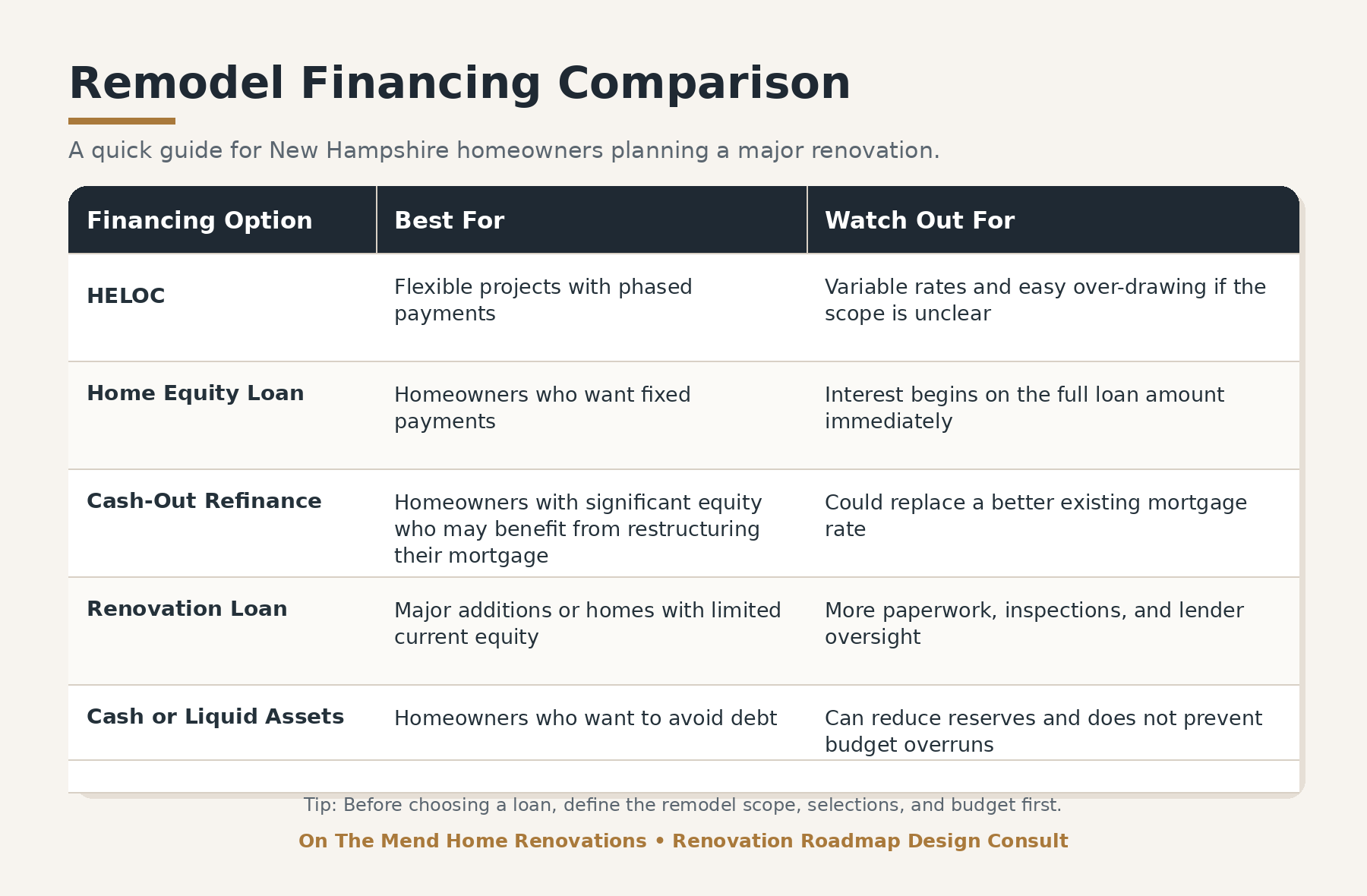
Remodel Financing Comparison Table
The Scope Creep Trap: Why Planning Is Part of Financing
The biggest threat to your remodel financing is not always the interest rate.
It is the estimate.
A vague estimate can make a $200,000 remodel look manageable on paper, only for the real number to climb once walls are opened, selections are made, materials are upgraded, and “small changes” start stacking on top of each other.
That is when homeowners end up trapped.
They either borrow more, drain cash reserves, delay parts of the project, or start making rushed compromises on the very details that made them want the remodel in the first place.
This is why the old remodeling model creates so much stress.
A homeowner asks, “How much will this cost?”
The contractor gives a rough number.
The homeowner tries to arrange financing around that number.
Then the project gets deeper into planning, design, selections, materials, and construction details.
Suddenly, the “rough number” is no longer accurate.
Now the homeowner is forced to make financial decisions under pressure.
That is not how a major remodel should work.
At On The Mend Home Renovations, we believe financing should come after clarity — not before it.
That is why we start with our Renovation Roadmap Design Consult.
Before you commit to a construction contract or walk into a lender’s office, we help you define the scope, selections, budget expectations, design direction, and construction plan.
The goal is simple:
You should not be financing a guess.
You should be financing a plan.
Why a Design-First Process Helps Protect Your Budget
A major remodel is not just a construction project.
It is a financial decision.
It affects your home, your lifestyle, your monthly obligations, your savings, your equity, and your long-term plans.
That is why starting with a vague quote is so risky.
A design-first process helps answer the questions that impact the real cost of the remodel:
What exactly is being remodeled?
What is included?
What is excluded?
What level of finishes are being selected?
Will walls move?
Will plumbing move?
Will electrical systems need upgrades?
Are structural changes involved?
Are there permit considerations?
What materials are being used?
What allowances are realistic?
What is the expected construction sequence?
What decisions need to be made before construction begins?
When these details are planned upfront, the budget becomes clearer.
When the budget becomes clearer, the financing conversation becomes easier.
Instead of going to a lender with a wish list and a rough contractor estimate, you can approach the financing conversation with a more professional roadmap.
That can help you make better decisions about how much to borrow, what financing option fits best, and whether the project should be completed all at once or phased strategically.
Financing Questions NH Homeowners Should Ask Before Remodeling
Before financing a major home renovation, ask these questions:
1. Do we have a clearly defined scope?
If the contractor cannot clearly explain what is included, what is excluded, and where the budget risk is, you may not be ready to finance the project yet.
2. Are our selections realistic for the investment range?
Cabinets, countertops, flooring, fixtures, tile, appliances, windows, doors, and exterior finishes can dramatically affect the final cost.
A budget without selections is often just an educated guess.
3. Are we borrowing based on a fixed plan or a rough estimate?
There is a big difference between financing a defined project and financing a ballpark number.
4. What happens if we want to upgrade during the project?
Some upgrades are easy to plan for.
Others can create delays, change orders, and added costs.
A good planning process helps identify these decisions before construction starts.
5. How much contingency should we have?
Even well-planned remodels can uncover unknowns, especially in older homes.
Your financing plan should account for potential surprises without creating panic.
6. Will this remodel improve how we actually live in the home?
Not every expensive remodel is a smart remodel.
The right plan should improve function, flow, comfort, aesthetics, and long-term enjoyment.
7. Are we working with a contractor who can help us create clarity before construction?
The contractor you choose should not just be able to build.
They should be able to guide you through the planning process so you can make confident decisions before the work begins.
Why On The Mend Starts With the Renovation Roadmap Design Consult
At On The Mend Home Renovations, we work with homeowners who want a beautiful result, but also want a controlled, professional process.
They do not want chaos.
They do not want vague allowances.
They do not want surprise invoices.
They do not want to feel like they are managing the remodel themselves.
They want a clear plan, a trusted team, and a process that respects their home, their investment, and their time.
That is exactly why we created the Renovation Roadmap Design Consult.
This is our design-first planning process for homeowners who want clarity before committing to a major remodel.
The Renovation Roadmap helps you think through:
Project scope
Design goals
Functionality needs
Budget expectations
Finish levels
Construction feasibility
Potential risks
Timeline expectations
Financing considerations
Next steps before construction
This process is especially valuable for homeowners planning a large investment such as:
Whole home remodels
Kitchen remodels
Bathroom remodels
Basement remodels
Additions
Primary suite renovations
Exterior upgrades
Multi-room transformations
A major remodel deserves more than a quick walkthrough and a rough estimate.
It deserves a plan.
The Real Cost of a Cheap or Vague Estimate
Many homeowners are tempted to collect three quick quotes and choose the one that feels most comfortable.
But the lowest or fastest estimate is not always the safest one.
Sometimes a low estimate is low because important details were missed.
Sometimes allowances are unrealistic.
Sometimes the contractor has not accounted for the real complexity of the project.
Sometimes the number looks good now but becomes painful later.
A vague estimate can lead to:
Budget overruns
Change order frustration
Financing shortfalls
Delayed timelines
Compromised finishes
Stress between spouses
Loss of trust with the contractor
A finished result that does not match the original vision
This is why the planning phase is so important.
The more clarity you create before construction, the fewer painful surprises you are likely to face during construction.
Local Considerations for New Hampshire Homeowners
Homeowners in New Hampshire often face a unique mix of remodeling considerations.
Many homes in Southern NH and the Lakes Region have strong equity, but they may also have older layouts, aging systems, seasonal considerations, and design challenges that affect the true cost of renovation.
A kitchen remodel in Bedford may have different expectations than a lake house renovation in Meredith.
A whole home remodel in Windham may require a different planning strategy than an addition in Merrimack.
A basement remodel in Nashua may come with different moisture, ceiling height, or egress considerations than a newer home in Amherst.
That is why local experience matters.
The more your contractor understands New Hampshire homes, local expectations, permitting considerations, seasonal scheduling, and the realities of remodeling in this region, the better your plan can be.
And the better your plan is, the easier it is to make smart financing decisions.
Important Note About Financial Advice
This article is for educational purposes only and should not be considered financial, tax, lending, or legal advice.
Before choosing a financing option, speak with a qualified lender, mortgage professional, financial advisor, or tax professional who can review your specific financial situation.
On The Mend Home Renovations can help you create a clearer remodeling plan, scope, and budget direction, but your financing decision should be made with the appropriate financial professionals.
Ready to Finance the Remodel Without Financing the Guesswork?
A major remodel is too important to build on vague numbers and crossed fingers.
Before you apply for a HELOC, refinance your mortgage, use a home equity loan, or commit to a renovation loan, start with a clear plan.
The Renovation Roadmap Design Consult gives you the clarity you need to understand your scope, budget, selections, and next steps before construction begins.
If you are considering a major home remodel in Merrimack, Bedford, Windham, Amherst, Hollis, Nashua, Southern NH, the Seacoast, or the Lakes Region, we would be happy to help you create a predictable path forward.
Stop wondering what the remodel might cost.
Stop trying to finance a guess.
Start with a roadmap.
Book Your Renovation Roadmap Discovery Call Today
Finally get the beautiful, functional home you have been thinking about — without the financial fog that makes remodeling feel risky.
Frequently Asked Questions About Financing a Home Remodel in New Hampshire
What is the best way to finance a $200,000 home remodel in New Hampshire?
The best financing option depends on your equity, credit profile, current mortgage rate, monthly payment comfort level, and overall financial goals. Common options include a HELOC, home equity loan, cash-out refinance, renovation loan, or cash reserves. Before choosing a financing option, it is wise to start with a clear remodel scope and budget so you know what you are actually financing.
Is a HELOC better than a home equity loan for a remodel?
A HELOC may be better if you want flexible access to funds and expect to draw money in phases. A home equity loan may be better if you want a fixed payment and a lump sum upfront. The right choice depends on your financial situation and how clearly your remodel budget has been defined.
Can I finance a home addition in New Hampshire?
Yes, many homeowners finance home additions using a HELOC, home equity loan, cash-out refinance, renovation loan, or a combination of financing and cash. Since additions can involve design, permitting, foundation work, framing, mechanical systems, and finish selections, it is important to have a detailed plan before finalizing your financing.
Should I get remodeling plans before applying for financing?
In many cases, yes. Having a clearer scope, design direction, and budget can help you make a more informed financing decision. It can also reduce the risk of borrowing too little, borrowing too much, or discovering mid-project that the original estimate was not realistic.
How much equity do I need to finance a major renovation?
Equity requirements vary by lender and loan type. Many lenders look closely at your loan-to-value ratio, credit score, income, debt-to-income ratio, and overall borrower profile. A lender or mortgage professional can help you understand how much equity may be available for your specific situation.
What causes remodeling projects to go over budget?
Common causes include vague scopes, unrealistic allowances, missing design details, changing selections during construction, hidden conditions, structural discoveries, and poor planning before the project begins. A design-first planning process can help reduce these risks.
Can a contractor help me understand the budget before I apply for a loan?
Yes. A professional remodeling contractor should help you understand the likely investment range, project scope, selections, and potential risk factors before you commit to construction. At On The Mend Home Renovations, our Renovation Roadmap Design Consult is designed to create this clarity before you make major financial decisions.